
Not too long ago, disc drives were an essential part of every computer. Whether you were installing software, watching movies, or backing up files, CDs and DVDs played a major role in how people used their devices.
Many of us remember the familiar sound of a disc drive spinning as it loaded a program or movie. It was once considered a core feature of desktop computers and laptops.
But today, things have changed dramatically. Most modern laptops and even many desktop computers no longer include disc drives at all.
At first, this shift felt strange to some users. After all, physical discs had been part of computing for decades. However, the technology landscape has evolved, and there are now several reasons why disc drives are no longer necessary for most people.
In this article, we’ll explore why disc drives are fading away, what technologies have replaced them, and why modern computing works perfectly fine without them.
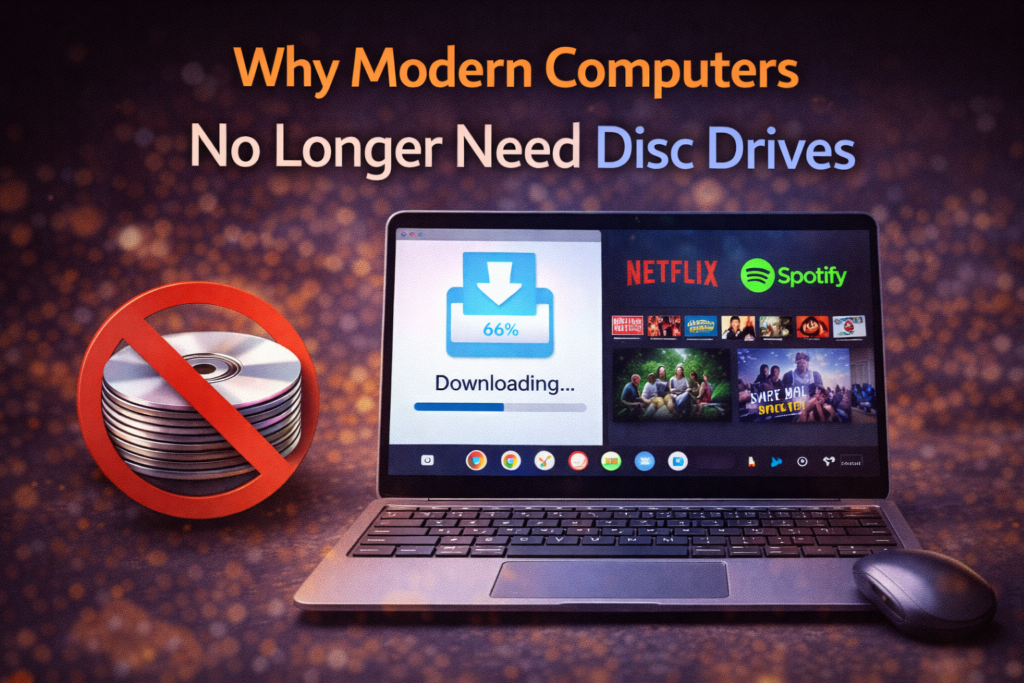
The Rise of Digital Technology
One of the biggest reasons disc drives are disappearing is the rise of digital distribution.
In the past, physical discs were the primary way to distribute software, movies, and music.
For example:
- Software was installed from CDs or DVDs
- Movies were watched using DVD players
- Music albums were purchased on CDs
Today, nearly all of these services have moved online.
Software can be downloaded directly from official websites, movies are streamed through entertainment platforms, and music is available instantly through streaming services.
Because of this shift, physical media is no longer required for everyday digital activities.
Faster Internet Changed Everything
High-speed internet connections have played a major role in replacing disc drives.
In the early days of the internet, downloading large files was slow and unreliable. Installing software from a disc was often faster than downloading it.
But modern broadband connections allow users to download gigabytes of data in minutes.
This means people can easily:
- Download operating systems
- Install applications
- Stream movies and shows
- Access cloud storage
As internet speeds improved, the need for physical installation media naturally decreased.
Cloud Storage Replaced Physical Backup Discs
In the past, people used discs to back up important files.
For example, photos, documents, and videos were often saved on DVDs to protect them from computer failures.
Today, cloud storage services have replaced this method.
Cloud platforms allow users to store files securely online and access them from multiple devices.
Advantages of cloud storage include:
- Automatic backups
- Easy file sharing
- Access from anywhere
- Reduced risk of losing data
Because files are stored online instead of on physical discs, disc drives are no longer necessary for backup purposes.
Streaming Replaced DVD and Blu-ray Movies
Another major change came from the rise of streaming services.
Watching movies used to require physical discs. People collected DVDs or Blu-ray discs and used disc drives or DVD players to watch them.
Today, streaming platforms allow users to watch movies instantly without needing physical media.
Streaming offers several benefits:
- Instant access to large libraries of content
- No need to store physical discs
- Easy viewing on multiple devices
- Automatic updates with new content
Because of this convenience, many people no longer purchase movies on discs.
Modern Laptops Are Designed for Portability
One reason manufacturers removed disc drives from laptops is to make devices thinner and lighter.
Disc drives require mechanical components and take up valuable space inside the computer.
By removing them, manufacturers can design laptops that are:
- Slimmer
- Lighter
- More energy efficient
- Easier to carry
This design change has helped create the modern ultra-thin laptops that many people prefer today.
USB Drives and External Storage Are More Convenient
In the past, discs were often used to transfer files between computers.
However, USB flash drives have largely replaced this function.
USB drives are small, portable, and capable of storing large amounts of data.
Advantages of USB storage include:
- Faster data transfer
- Reusable storage
- Compact size
- Compatibility with many devices
Compared to discs, USB drives are much more convenient for sharing files.
Software Installation Is Now Fully Digital
Most modern software is distributed digitally.
Operating systems, productivity tools, and games can all be downloaded online.
Developers prefer digital distribution because it allows them to:
- Update software easily
- Deliver patches quickly
- Reduce manufacturing costs
For users, downloading software is often faster than installing it from a physical disc.
Gaming Has Also Moved Toward Digital Downloads
Gaming once relied heavily on discs.
Console games and PC games were commonly sold in physical form.
Today, digital game stores allow players to download games directly to their devices.
Digital game libraries provide several advantages:
- Instant access to purchased games
- No need to switch discs
- Automatic updates
- Cloud saves
Because of these features, many gamers now prefer digital downloads.
Are Disc Drives Completely Obsolete?
Although disc drives are no longer common, they are not entirely obsolete.
Some users still rely on them for specific purposes.
For example:
- Accessing older software stored on discs
- Playing DVD or Blu-ray collections
- Archiving physical media
However, these situations are becoming increasingly rare.
For most people, digital alternatives provide a more convenient solution.
External Disc Drives Still Exist
For users who occasionally need a disc drive, external USB disc drives are available.
These devices connect to computers through a USB port and allow users to read CDs or DVDs when necessary.
Because they are external, they do not add bulk to laptops that rarely use them.
The Future of Data Storage
Technology continues to move toward faster and more flexible storage methods.
Future storage solutions may include:
- Faster cloud synchronization
- Improved wireless data transfer
- Larger portable storage devices
- Advanced online collaboration tools
As these technologies develop, the need for physical media will likely continue to decline.
Final Thoughts
Disc drives once played an important role in the evolution of personal computing. They allowed users to install software, watch movies, and back up important data.
However, modern technology has introduced faster, more convenient alternatives.
High-speed internet, cloud storage, streaming platforms, and portable USB drives have all contributed to the gradual disappearance of disc drives from modern computers.
While physical media may still have a place for collectors or specialized use cases, most everyday computing tasks no longer require disc drives.
For many users, the shift toward digital solutions has made computing simpler, faster, and more flexible.
Frequently Asked Questions
Why do modern laptops no longer include disc drives?
Manufacturers remove disc drives to make laptops thinner, lighter, and more portable.
Can I still use discs on a modern computer?
Yes. External USB disc drives allow computers to read CDs or DVDs if needed.
What replaced CDs and DVDs for software installation?
Most software is now downloaded directly from the internet or installed through digital stores.
Are discs still used for movies?
Some collectors still buy DVDs or Blu-ray discs, but many people now prefer streaming services.
Is physical media completely gone?
Not entirely, but its use has significantly decreased as digital technology becomes more common.
SHARING IS CARING 💖