
Artificial intelligence assistants have rapidly evolved over the past decade. What began as simple voice-command tools capable of answering basic questions has transformed into intelligent systems capable of managing schedules, controlling smart homes, and assisting with daily tasks.
Today’s AI assistants are smarter, faster, and more capable than ever before. Thanks to advances in machine learning, natural language processing, and cloud computing, these digital helpers can understand complex commands, learn from user behavior, and provide increasingly personalized experiences.
In this article, we explore why AI assistants are becoming smarter, how the technology works, and what this means for everyday users.
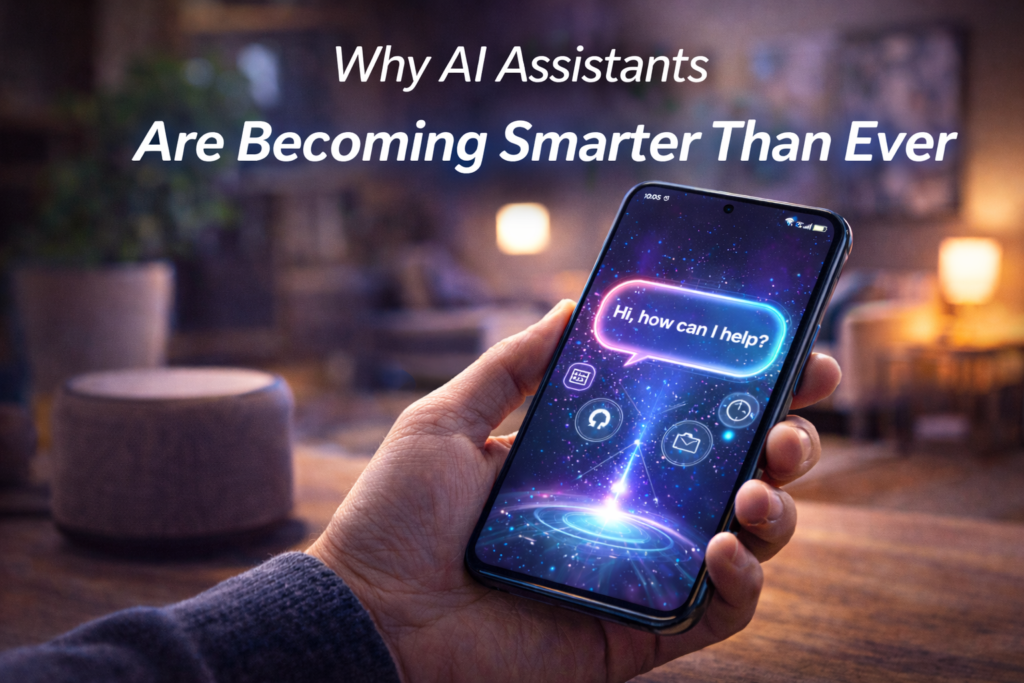
What Are AI Assistants?
AI assistants are software programs designed to help users perform tasks using voice commands, text input, or automated actions. They rely on artificial intelligence technologies to understand human language and respond appropriately.
These assistants can perform a wide range of tasks, including:
- Setting reminders
- Answering questions
- Playing music
- Managing smart home devices
- Sending messages and emails
- Searching the internet
Examples of AI assistants include those built into smartphones, smart speakers, and other connected devices.
As technology advances, these assistants continue to improve their ability to understand context and deliver helpful responses.
The Role of Machine Learning
One of the main reasons AI assistants are becoming smarter is the rapid advancement of machine learning technology.
Machine learning allows computers to analyze large amounts of data and identify patterns. Over time, AI systems can learn from this data and improve their performance.
For AI assistants, this means they can:
- Understand speech more accurately
- Recognize user preferences
- Provide better recommendations
- Improve responses based on previous interactions
For example, if a user frequently asks about traffic conditions before commuting, the assistant may automatically start providing traffic updates each morning.
This ability to learn from experience makes AI assistants more useful and efficient.
Improvements in Natural Language Processing
Another major factor behind smarter AI assistants is the advancement of natural language processing (NLP).
Natural language processing allows computers to understand human language in a more natural way. Instead of requiring specific commands, users can speak conversationally.
For example, instead of saying:
“Set reminder for 7 PM.”
Users can now say:
“Remind me to call my friend later tonight.”
Modern AI assistants can interpret the intent behind such requests and respond accordingly.
NLP technology has significantly improved voice recognition accuracy, allowing assistants to understand different accents, speech patterns, and languages.
Integration With Smart Home Devices
AI assistants have become central components of modern smart homes.
Many households now use voice assistants to control devices such as:
- Smart lights
- Thermostats
- Security cameras
- Smart speakers
- Home appliances
By connecting multiple devices to a central assistant, users can control their entire home environment using simple voice commands.
For example, a user can say:
“Turn off the lights and lower the temperature.”
The assistant can execute multiple actions simultaneously.
This level of integration makes AI assistants increasingly valuable for managing everyday tasks.
Personalized User Experiences
Modern AI assistants are designed to provide personalized experiences tailored to each user.
By analyzing behavior patterns and preferences, AI systems can offer customized suggestions.
Examples include:
- Recommending music playlists based on listening habits
- Suggesting calendar reminders based on routines
- Providing traffic alerts before daily commutes
- Recommending nearby restaurants based on past searches
These personalized features make AI assistants feel more intuitive and responsive.
Instead of simply responding to commands, assistants can proactively provide useful information.
Faster Processing With On-Device AI
Another reason AI assistants are becoming smarter is the development of on-device AI processing.
In the past, many AI assistant functions required sending data to cloud servers for processing. While this approach provided powerful computing resources, it also introduced delays and raised privacy concerns.
Modern smartphones and devices now include specialized processors designed to run AI algorithms directly on the device.
This allows assistants to process commands more quickly and reduces the need to transmit sensitive data externally.
On-device AI improves both performance and privacy.
AI Assistants in Productivity and Work
AI assistants are increasingly used to improve productivity in professional environments.
They can help manage tasks such as:
- Scheduling meetings
- Organizing calendars
- Sending reminders
- Managing email messages
- Taking notes during meetings
Some assistants can even summarize long documents or generate quick responses to emails.
These capabilities help professionals save time and focus on more important tasks.
As AI assistants become more advanced, they may play an even larger role in workplace productivity.
AI Assistants and Language Translation
Another area where AI assistants have improved significantly is language translation.
Modern assistants can translate spoken or written language almost instantly.
This capability allows users to communicate with people who speak different languages without needing specialized translation tools.
Real-time translation is particularly useful for:
- International travel
- Business communication
- Online learning
- Multilingual collaboration
AI translation tools continue to improve as machine learning models analyze larger datasets of language patterns.
AI Assistants and Accessibility
AI assistants also play an important role in improving accessibility for people with disabilities.
Voice commands allow users to interact with devices without needing physical input.
For individuals with visual impairments or mobility challenges, voice assistants provide an accessible way to:
- Send messages
- Make phone calls
- Access information
- Control smart home devices
These features help make technology more inclusive and accessible to a wider range of users.
Privacy and Security Considerations
As AI assistants become more capable, privacy concerns have also increased.
Many assistants rely on analyzing user data to provide personalized experiences.
This raises questions about how data is collected, stored, and used.
Technology companies are addressing these concerns by introducing stronger privacy protections, including:
- On-device processing
- Improved encryption
- Clearer privacy controls
Users can also review privacy settings and manage how their data is used by AI systems.
Balancing convenience with privacy remains an important challenge in the development of AI technology.
The Future of AI Assistants
AI assistants are expected to continue evolving in the coming years.
Future improvements may include:
- More advanced conversational abilities
- Improved contextual understanding
- Integration with augmented reality technologies
- Better emotional recognition and response
These advancements could allow assistants to provide even more natural interactions and assist users in increasingly complex tasks.
As artificial intelligence continues to develop, digital assistants may become essential tools for managing both personal and professional life.
Final Thoughts
AI assistants have come a long way from their early beginnings as simple voice-command tools. Today, they are intelligent systems capable of understanding natural language, learning user preferences, and managing complex tasks.
Advancements in machine learning, natural language processing, and on-device computing have made these assistants faster, smarter, and more reliable.
As technology continues to evolve, AI assistants will likely become even more integrated into daily life, helping users save time, stay organized, and interact with technology more naturally.
Understanding how these systems work can help users take full advantage of the powerful tools now available in modern devices.
SHARING IS CARING 💖