
Online search has evolved dramatically over the past two decades. In the early days of the internet, search engines primarily matched keywords in web pages with the words typed by users. While this approach helped people find information, it often produced results that were incomplete or difficult to interpret.
In 2026, artificial intelligence is transforming online search in powerful ways. AI-powered search systems can now understand context, interpret natural language questions, and deliver more accurate results in seconds. Instead of simply matching keywords, modern search engines analyze the intent behind a search query and provide meaningful answers.
These advancements are changing how people interact with information online and how websites create content for search engines.
In this article, we explore how artificial intelligence is transforming online search, the technologies behind this transformation, and what it means for internet users and content creators.
The Evolution of Search Technology
Search engines have continuously evolved to improve how users find information.
Early Keyword-Based Search
Early search engines relied heavily on keyword matching. Users needed to type very specific phrases to obtain relevant results.
For example, a user searching for information about smartphones might need to type something like:
“Best smartphone models comparison.”
Even small differences in wording could produce completely different results.
Algorithm-Based Search Improvements
As search technology improved, search engines introduced algorithms designed to rank web pages based on relevance, authority, and content quality.
These algorithms considered factors such as:
- Website credibility
- Content structure
- User engagement
- Backlinks from other websites
These improvements helped deliver better results, but search engines still relied heavily on keyword signals.
The Role of Artificial Intelligence in Search
Artificial intelligence has fundamentally changed how search engines process queries and deliver results.
Modern search systems now use AI models capable of analyzing large amounts of data and understanding the meaning behind user queries.
Instead of focusing only on keywords, AI search systems evaluate:
- Context
- User intent
- Previous search behavior
- Semantic meaning of words
This allows search engines to provide more relevant answers, even when users ask complex questions.
Natural Language Search
One of the most noticeable changes in AI-powered search is the ability to understand natural language queries.
Users no longer need to type short keyword phrases. Instead, they can ask full questions in conversational language.
For example, users might search:
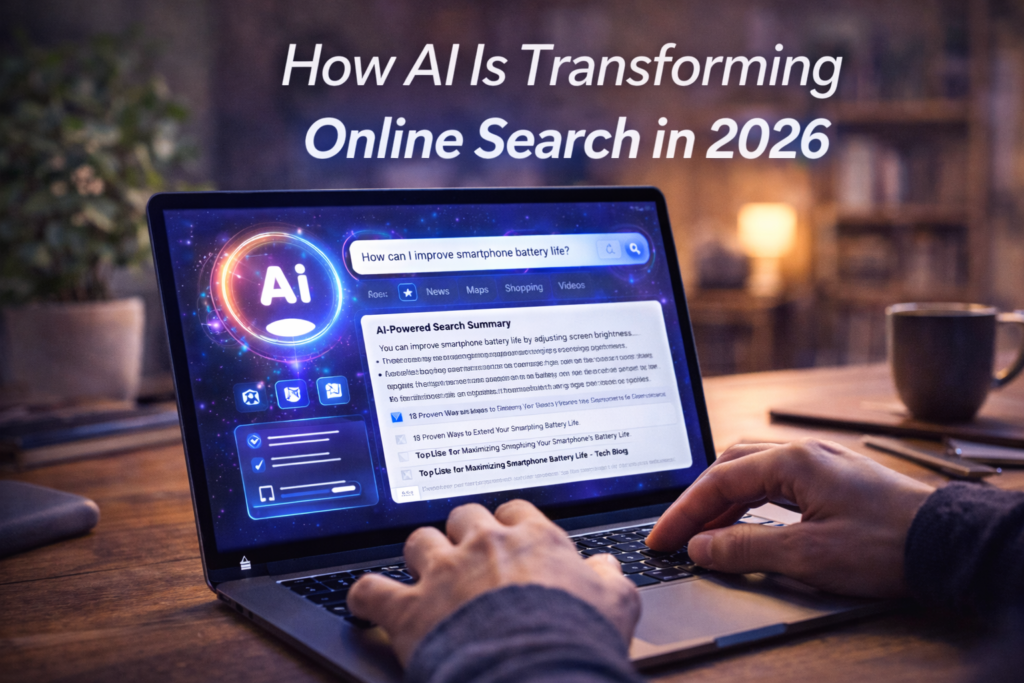
“What is the best way to improve smartphone battery life?”
AI search systems can analyze the entire sentence, understand the topic, and provide helpful results.
This capability makes search engines easier to use and more accessible to a wider audience.
AI-Powered Search Summaries
Another major development in AI search is the introduction of automated search summaries.
Instead of requiring users to visit multiple websites, search engines can now generate summarized answers directly on the results page.
These summaries combine information from various sources to provide quick explanations.
For example, when searching for a complex topic, users may see a short overview explaining the subject before scrolling through traditional search results.
This feature helps users find information faster and reduces the time spent browsing multiple websites.
Personalized Search Experiences
Artificial intelligence also enables search engines to deliver more personalized results.
Search systems analyze user behavior, including:
- Previous searches
- Location information
- Device type
- Content preferences
Using this data, AI can prioritize results that are most relevant to each individual user.
For example, someone searching for restaurants may receive recommendations based on nearby locations and previous dining preferences.
Personalized search experiences help users discover more useful content.
Voice Search and AI Assistants
Voice search has become increasingly popular thanks to AI assistants integrated into smartphones and smart devices.
Instead of typing queries, users can simply speak their questions.
AI-powered voice recognition systems convert spoken language into text and analyze the request using natural language processing.
Voice search is commonly used for tasks such as:
- Checking the weather
- Finding nearby businesses
- Searching for quick facts
- Navigating directions
As voice recognition technology continues to improve, voice search is expected to play an even larger role in how people access information.
Visual Search Technology
Artificial intelligence has also introduced visual search capabilities.
Visual search allows users to search for information using images instead of text.
For example, a user might take a photo of an object, plant, or product and upload it to a search engine.
AI image recognition systems analyze the photo and identify similar objects or provide relevant information.
This technology is particularly useful for:
- Shopping comparisons
- Identifying plants or animals
- Learning about landmarks
- Finding product information
Visual search demonstrates how AI is expanding the ways users interact with search engines.
The Impact on Website Content
As AI transforms search technology, website content strategies are also evolving.
Content creators now focus more on providing useful and well-structured information rather than simply optimizing for keywords.
Search engines increasingly prioritize content that:
- Answers user questions clearly
- Provides reliable information
- Demonstrates expertise on a topic
High-quality content is more likely to appear in AI-generated summaries and top search results.
This shift encourages websites to focus on user value rather than outdated keyword strategies.
Benefits of AI-Powered Search
Artificial intelligence offers several advantages for online search.
Faster Information Access
AI systems can analyze complex queries and deliver accurate results quickly.
Improved Search Accuracy
Understanding context and intent allows search engines to provide more relevant results.
More Interactive Experiences
Features such as voice search and visual search make finding information easier and more engaging.
Enhanced Personalization
AI enables search engines to tailor results based on individual preferences and behaviors.
Challenges and Concerns
Despite its benefits, AI-powered search also raises several important challenges.
Information Accuracy
AI-generated summaries must rely on reliable data sources to ensure accuracy.
Incorrect or outdated information can sometimes appear in automated results.
Content Attribution
As search engines generate summaries, questions arise about how content creators receive credit for their work.
Balancing convenience for users with fair recognition for publishers remains an ongoing discussion.
Privacy Considerations
Personalized search experiences rely on analyzing user behavior.
Search companies must ensure that user data is handled responsibly and securely.
The Future of Online Search
Artificial intelligence will continue to shape the future of online search.
Potential future developments include:
- More conversational AI search interfaces
- Advanced knowledge graphs connecting information across topics
- Real-time personalized recommendations
- Integration with augmented reality technologies
These innovations may allow users to interact with search engines in ways that feel more like conversations with intelligent assistants.
Search may eventually become a fully interactive experience rather than a list of web links.
Final Thoughts
Artificial intelligence is transforming online search in remarkable ways. By understanding natural language, analyzing context, and generating helpful summaries, AI-powered search engines are making it easier for users to find accurate information quickly.
These improvements are changing not only how people search for information but also how websites create and present content online.
As AI technology continues to evolve, online search will likely become even more intelligent, personalized, and interactive.
Understanding these changes can help users and content creators adapt to the future of digital information.
SHARING IS CARING 💖